As an Amazon Associate this site earns from qualifying purchases.
Quick Picks
| Product | Form | Best for | Link |
|---|---|---|---|
| Today - Iron Cleaner Stick for Hot Soleplate | Stick, applied to a hot plate | Baked-on starch and scorch marks you want gone in one pass | Check Price on Amazon |
| Today - (2x) Iron Cleaner Stick for Hot Soleplate | Stick, two-pack | Households that iron often enough to reorder | Check Price on Amazon |
| Iron Soleplate Cleaner - Steamer Iron Plate Burn Stain Mark Remover Spray | Spray | Garment steamer plates and irons you would rather not touch with a hot stick | Check Price on Amazon |
Disclosure: We earn a small commission from qualifying Amazon purchases at no extra cost to you.
As an Amazon Associate we earn from qualifying purchases. This page contains affiliate links, and we may receive a commission if you buy through them — at no extra cost to you.
As an Amazon Associate, we earn from qualifying purchases.
Last Updated: September 2026
Here's the short version. To clean a steam iron soleplate, cool the iron completely, scrub cold-safe residue off with a bicarbonate-of-soda paste or a dedicated soleplate cleaner, clear every steam vent with a cotton swab, then run the descale or self-clean cycle with the tank filled to flush mineral scale out of the boiler. Two different problems, two different fixes — the brown gunk on the outside of the plate and the white scale inside the tank are not the same fault, and treating one does nothing for the other.
That distinction is the whole guide. Most people scrub the plate, see the stain return two shirts later, and conclude the iron is dying. It usually isn't.
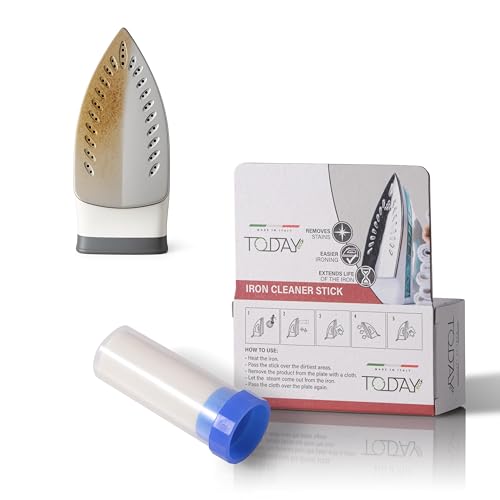
- QUICK CLEANING: Removes limescale, dirt, starch deposits, fabric fibres and other residues that accumulate on the iron soleplate. These deposits can reduce ironing efficiency and
- EASY TO USE: Designed for fast and effortless application. Simply apply the stick directly onto the hot soleplate and wipe away with a cloth to instantly dissolve built-up
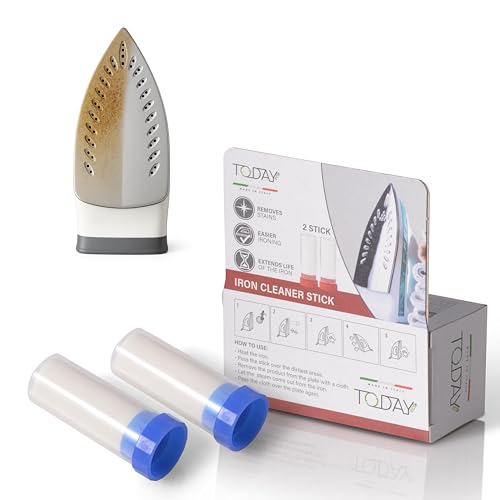
- QUICK CLEANING: Removes limescale, dirt, starch deposits, fabric fibres and other residues that accumulate on the iron soleplate. These deposits can reduce ironing efficiency and
- EASY TO USE: Designed for fast and effortless application. Simply apply the stick directly onto the hot soleplate and wipe away with a cloth to instantly dissolve built-up
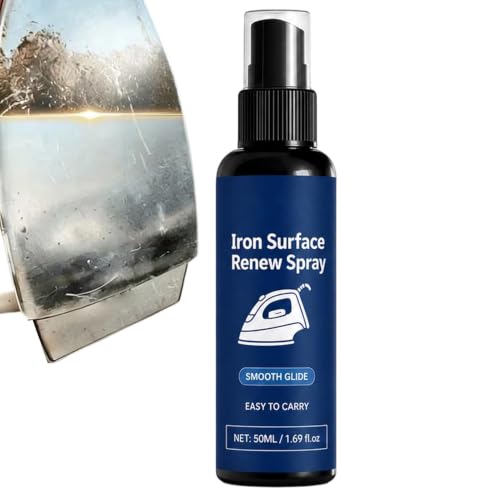
- Renews Iron Soleplates: This iron cleaner soleplate restores your iron's soleplate, removing carbon buildup and burn marks for a visible renewal effect. It works on various iron
- Iron Plate Renewal: Designed as an iron plate cleaner and soleplate restorer, this product clears sticky stains and rescues rough , coated plates from buildup drag. The formula
The Problem: Two Faults That Look Like One
A steam iron fails in two directions at once, and they have nothing to do with each other.
Outside the plate, you get residue: melted synthetic fibre, spray starch that has carbonised into a brown lacquer, fusible interfacing adhesive, sizing from new fabric. It builds in a thin film that drags instead of glides, and it transfers onto the next light-coloured shirt you press.
Inside the tank and boiler, you get limescale. Tap water carries dissolved calcium and magnesium; the water leaves as steam and the minerals stay behind, crusting the heating element and narrowing the steam channels. That is the honest answer to why is my iron spitting brown water: scale flakes loose, mixes with the water still in the chamber, and gets pushed out of the vents onto your clothes. Brown rather than white usually means the flakes have picked up whatever was already sitting in the steam ports.
Scrubbing the soleplate will never fix spitting. Descaling will never lift a scorch mark. Do both.
Step-by-Step: How to Clean a Steam Iron Soleplate
- Unplug it and let it cool completely — unless you are using a hot-application stick product, which is designed for the opposite (more on that below). Never take an abrasive to a plugged-in appliance.
- Empty the water tank. Tip it out over a sink. You do not want water in the reservoir while you are working the plate.
- Wipe off the loose film. A damp microfibre cloth takes the top layer of starch and lint before you commit to anything harsher.
- Make a bicarbonate paste — roughly two parts bicarbonate of soda to one part water — and work it over the stained area with a soft cloth in small circles. It is mildly abrasive, which is the point, and it will not scratch a stainless or ceramic plate the way a scouring pad will.
- Or use a purpose-made soleplate cleaner. Faster for baked-on scorch, and the right call if the residue has gone glassy and brown. See the tools section.
- Clear every steam vent. Cotton swab dipped in distilled white vinegar, twisted into each hole. This is the step everyone skips and it is where the brown deposits actually live.
- Wipe the plate clean with a fresh damp cloth, then dry it. Any cleaner residue left on the plate is going onto your next garment.
- Press a scrap of old cotton or a folded towel on high heat with steam for thirty seconds to purge whatever you loosened.
Step-by-Step: How to Descale a Steam Iron With Vinegar
This is the fix for spitting, sputtering, and weak steam.
- Check your manual first. Some manufacturers void warranty coverage for vinegar in the tank, and irons with a sealed anti-calc cartridge want a proprietary tablet instead. Two minutes of reading beats a dead iron.
- Fill the tank one-third with distilled white vinegar and two-thirds with distilled water. Not neat vinegar — it is acidic enough to attack seals and gaskets over time.
- Heat the iron to its maximum steam setting and let it come fully up to temperature.
- Steam it over a sink or an old towel for five to ten minutes, pressing the steam-burst button repeatedly. You want the solution moving through the channels, not just sitting in the reservoir.
- Empty the tank, refill with plain distilled water, and steam it out again — twice. Vinegar left in the boiler will scent the next thing you iron, and that smell does not come out of wool.
- Finish with the self-clean function on your steam iron if it has one. That is typically a button or dial position that dumps the tank contents through the plate in one hot rush, carrying loosened scale with it. Hold the iron over the sink, plate down, and expect discoloured water and grit. That is the job working.
- Wipe the plate, dry the vents, and store the iron upright with the tank empty.
Should You Use Distilled Water in a Clothes Iron?
Direct answer: distilled water in a clothes iron prevents scale, because distillation removes the dissolved minerals that form it. But a lot of manufacturers specifically ask for a mix rather than pure distilled, because completely demineralised water can promote leaking and spitting in some designs and shortens the life of certain anti-calc systems.
The safe default when your manual is silent: a 50/50 blend of distilled and tap water. If your tap water is genuinely hard, lean harder toward distilled. Never use filtered-jug water and call it distilled — a carbon filter removes taste, not calcium.
Tools and Products You'll Need
Bicarbonate of soda, distilled white vinegar, distilled water, microfibre cloths and cotton swabs cover most of it. Where a dedicated product earns its place is baked-on scorch that paste will not shift.
One honest caveat before the recommendations. The listings for all three products below publish the product name and category and little else in the verified record available here; none of them publish an ingredient list, a net weight, a plate-material compatibility chart, or a rating count that this page can cite. So the comparison below is about form factor and stated function, which is what the evidence actually supports. It is not a performance ranking, and nobody here has used any of them.
Today - Iron Cleaner Stick for Hot Soleplate — Best for baked-on starch on a single household iron
The listing describes this as an iron cleaner stick for a hot soleplate, sold as a steam iron residue remover and plate descaler that removes stains and starch, and states it is made in Italy [S3]. That "for hot soleplate" detail is the whole design premise: it is meant to be applied to a plate at temperature, where softened starch and scorch release far more readily than they do cold. If you have ever fought a cold scorch mark with a cloth, you know why that matters.
The stick format also means you are rubbing a solid over a hot metal surface, which is a different risk profile from a spray — keep your fingers clear and work over a heat-safe surface.
Pros
- Purpose-built for hot application, which targets the exact residue type (carbonised starch) that cold methods handle worst [S3]
- The listing names both residue removal and plate descaling as functions [S3]
- Requires you to work on a live, hot appliance — genuinely less forgiving than a cold-plate method, and a poor fit if you are cleaning an iron with a child or pet underfoot
- The listing available here does not publish an ingredient list, net weight, or a statement of compatibility with non-stick and ceramic coatings, so owners of coated plates are working without guidance from the manufacturer [S3]
Today - (2x) Iron Cleaner Stick for Hot Soleplate — Best for frequent ironing or two irons in the house
This is the same stick in a two-pack, described in the listing as a hot-soleplate iron cleaner stick, steam iron residue remover and plate descaler, made in Italy [S4]. Same product, same hot-application method, doubled.
Here's the thing: the sensible reason to choose it is not a discount you can verify — the listing available here publishes no price for either pack, so check the current price on Amazon for both and compare before assuming the multipack is cheaper per stick. The sensible reason is supply. If you iron work shirts several times a week, or you keep an iron upstairs and a second in the laundry, running out mid-task is the actual annoyance.
Pros
- Two units in one order, which suits regular ironing schedules or a two-iron household [S4]
- Identical stated function to the single pack, so the choice is purely quantity [S4]
- No published price or per-unit cost in the record available here, so the multipack's value is unverified rather than established [S4]
- Same hot-plate handling requirement as the single stick, and the same absence of published ingredient or coating-compatibility information [S4]
Iron Soleplate Cleaner - Steamer Iron Plate Burn Stain Mark Remover Spray — Best for garment steamers and hands-off application
The listing describes this as an iron soleplate cleaner and a steamer iron plate burn stain mark remover in spray form [S5]. Two things follow from that.
First, it names steamers alongside irons, which matters if the appliance you are cleaning is a garment steamer head rather than a flat iron plate — steamer plates have awkward geometry that a stick is clumsy against. Second, a spray puts distance between your hand and the surface. For anyone nervous about the hot-stick method, that is the meaningful difference.
Pros
- Spray delivery reaches vents and contoured steamer heads that a solid stick cannot press into evenly [S5]
- Listing explicitly covers burn and stain marks on steamer plates, not just flat irons [S5]
- The listing available here does not state the application temperature, so you do not know from the manufacturer whether to use it hot or cold — the one instruction that most affects whether it works
- No published ingredient list, volume, or coating-compatibility statement in the record available here [S5]
Tips for Best Results
- Descale on a schedule, not on a symptom. By the time it spits, scale has been building for months.
- Empty the tank every single time. Water sitting in a warm reservoir is how mineral deposits and mustiness both start.
- Iron dark and synthetic fabrics last, after the plate is clean, and at the lowest temperature that works. Most scorch damage happens on polyester.
- Stop using spray starch directly on the garment under the iron. Spray it, let it dry for thirty seconds, then press. Wet starch is what bakes onto the plate.
- Store it upright, tank empty, plate untouched by anything.
Common Mistakes to Avoid
- Using neat vinegar in the tank. Dilute it. Undiluted acetic acid works on seals as well as scale.
- Scraping with metal. A butter knife will take the coating off a ceramic plate in one stroke.
- Skipping the rinse cycles after descaling. Two plain-water flushes minimum, or your next white shirt smells like a chip shop.
- Assuming a cleaner fixes spitting. Soleplate products address the plate surface. Spitting is a tank-and-boiler problem.
- Cleaning a hot iron with a method meant for a cold one — or the reverse. The hot-application sticks above are explicitly designed for a hot plate [S3]; a bicarbonate paste is not.
- Ignoring the manual on water type. The manufacturer of your specific iron has an opinion about distilled water and it overrides general advice, including this page's.
How We Research
This page is built from published listing data, not from handling. For each of the three products above, we pulled the verified product record from the Amazon Creators API on 5 September 2026 and read what the listing actually states about form, function and origin [S3][S4][S5]. Where a field is absent — ingredients, volume, ratings, price, coating compatibility — this page says so rather than filling it from elsewhere, which is why the product sections above compare application method instead of cleaning performance. The cleaning and descaling procedure itself is standard appliance-care practice and is presented as method, not as a manufacturer specification. General consumer safety and recall guidance for household appliances is published by the CPSC [S1] and consumer protection resources are collected at USA.gov [S2].
Final Verdict
Do the vinegar descale first. It is nearly free, it fixes the fault that actually ruins garments, and if your iron is spitting brown water it is the only step that will help.
For the plate itself, buy a dedicated cleaner only when bicarbonate paste has failed on a scorch mark. If it has: the Today - Iron Cleaner Stick for Hot Soleplate is the choice for a standard flat iron plate, because its listing specifies hot-plate application and names starch removal directly [S3] — starch being the residue that cold methods handle worst. Go to the Today - (2x) Iron Cleaner Stick for Hot Soleplate only if you iron frequently and the current price per stick is better [S4]. Choose the Iron Soleplate Cleaner - Steamer Iron Plate Burn Stain Mark Remover Spray if you are cleaning a garment steamer head, or if applying anything to a hot appliance makes you uneasy [S5].
None of these three publishes enough specification detail here to call one better-performing than another. What differs, and what you can actually decide on, is the application method.
Frequently Asked Questions
Related Resources
- How to choose a garment steamer
- Steam iron vs garment steamer
- Best irons for quilting and sewing
Sources & Methodology
This website does not physically or laboratory-test products, and no one here has used, heated or applied any of the three cleaners named above. What informed this page is the verified product record for each ASIN retrieved from the Amazon Creators API on 5 September 2026, read closely for what it does and does not state — form factor, stated function, country of manufacture — alongside CPSC and USA.gov consumer resources for general appliance-safety context. For a category like iron cleaners, where listings publish function but not formulation, that evidence is enough to tell you which application method suits your appliance and your comfort level, and not enough to tell you which one dissolves scorch fastest; treat the plate-cleaning and descaling procedure above as the part of this guide with the most durable value.