As an Amazon Associate this site earns from qualifying purchases.
Quick Picks
| Product | Manufacturer-stated power | Best for |
|---|---|---|
| Rowenta Pure Force 2in1 Steamer & Iron: Powerful 1875 Watts | 1875 watts [S4] | Longest uninterrupted sessions, 7.1 oz XL tank [S4] |
| SALAV Retro Edition Duopress Handheld Garment Steamer & Iron | 1000 watts [S3] | Ceramic-plate handheld in Titanium |
| SALAV Retro Edition Duopress Handheld Garment Steamer & Iron | 1000 watts [S5] | Same handheld in Emerald |
Disclosure: We earn a small commission from qualifying Amazon purchases at no extra cost to you.
As an Amazon Associate we earn from qualifying purchases. This page contains affiliate links, and we may receive a commission if you buy through them — at no extra cost to you.
As an Amazon Associate, we earn from qualifying purchases.
Last Updated: September 2026
Here is the short answer to "garment steamer vs iron which is better": neither one wins outright, because they solve two different problems. A steamer relaxes wrinkles by pushing hot vapor through fabric while the garment hangs. An iron presses wrinkles flat by pushing a heated soleplate against fabric laid on a board. Steam relaxes. A plate presses. If you want a knife-edge crease on a dress shirt or slacks, you need the plate. If you want a suit jacket, curtain, or knit dress to look presentable in three minutes, you want steam.
The interesting development for 2026 is that you increasingly do not have to choose. All three products covered on this page are 2-in-1 units that do vertical steaming and horizontal ironing from one body, which changes the buying question from "which tool" to "how much wattage and tank do I need."
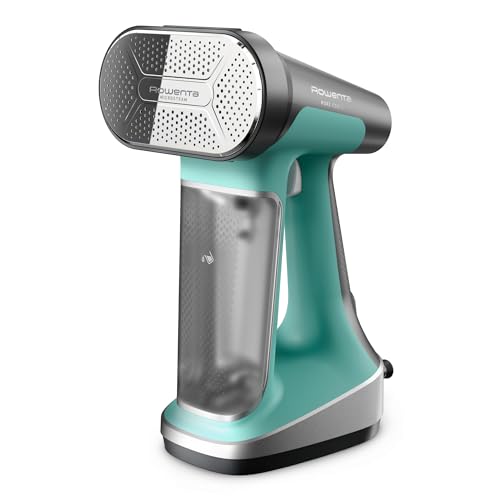
- VERSATILE 2-IN-1 MARVEL: Seamlessly transition between vertical steaming and horizontal ironing with this revolutionary steamer for
- XL POWER, UNMATCHED EFFICIENCY: Elevate your ironing experience with a 40% larger XL soleplate and 300% more steam, guaranteeing precision and efficiency with our garment steamer
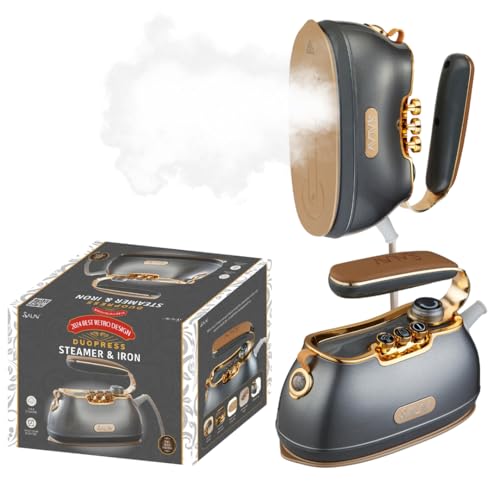
- 2-IN-1 DUOPRESS STEAMER & IRON – Versatile handheld clothes steamer and iron in one, perfect for wrinkle removal, garment care, and fabric refreshing. Ideal for everyday use
- STEAM AT ANY ANGLE, NO LEAKS – Advanced no-drip boiler system allows safe vertical and horizontal steaming without spills. Easily steam hanging garments, wedding dresses, suits
The Problem: You Bought the Wrong Tool for Your Closet
Most people who complain that "steamers do not work" are aiming steam at heavy cotton and expecting a crease. Most people who complain that irons are a chore are trying to press a pleated skirt or a hanging blazer flat on a board. The tool was fine. The match was wrong.
Fabric decides. Loose weaves, knits, jersey, silk, polyester blends, and anything with structure sewn into it respond to steam because the fibers just need heat and moisture to relax back. Dense cotton, linen, oxford cloth, and anything where you want a permanent, sharp line respond to a soleplate, because pressure plus heat is what sets a crease.
Do Steamers Remove Wrinkles as Well as Irons?
For relaxing wrinkles, yes. For creating creases, no. A steamer has no mechanism to flatten fabric — it applies vapor and lets gravity and fiber relaxation do the rest. Wrinkles fall out; they do not get pressed in a new shape. That is why a steamed dress shirt looks smooth and soft, while an ironed one looks smooth and crisp.
The honest verdict: a steamer gets a shirt about 85 percent of the way to ironed for a fraction of the setup, and the missing 15 percent is exactly the part that matters for interviews, uniforms, and formalwear.
Handheld vs Full Size Steamer
Handheld units keep the water tank inside the body you hold. That makes them portable and storable, but the tank has to stay small enough to carry, so refills come more often on a long session. Full-size standing steamers park a large reservoir on a base and feed steam up a hose, so run time is longer, but you are moving furniture, not packing a suitcase.
All three products here are handheld-class 2-in-1 devices. Among them, the Rowenta is the one that publishes a tank figure: 7.1 oz, described on the listing as an XL tank capacity [S4]. Neither SALAV listing publishes a tank capacity, so there is no way to say from the supplied data how the two compare on refill frequency.
Step-by-Step: Getting the Best Result From Each Tool
How to steam a garment
- Hang the garment on a sturdy hanger with room behind it, and empty the pockets so nothing distorts the drape.
- Fill the reservoir with water and let the unit reach temperature before the first pull of the trigger.
- Work top to bottom in slow vertical passes, keeping the head close but not scrubbing the fabric.
- Use your free hand to lightly pull the hem taut — tension plus steam is what does the work.
- Let the garment hang and dry for a few minutes before wearing it, since damp fabric re-wrinkles instantly.
How to iron a garment
- Set up a board and check the care label for the correct heat setting before you plug anything in.
- Start with the lowest-heat items — synthetics before cotton — so you never have to wait for a plate to cool down.
- Press collars, cuffs, and plackets first, then the body panels, then sleeves last.
- Move continuously. A stationary hot plate on a synthetic is how garments get shiny scorch marks.
- Hang the item immediately while it is still warm so the fresh press sets.
Tools and Products You'll Need
Recommended Products
These three are the 2-in-1 units this page is built on. Each one steams vertically and irons horizontally, so they are the practical answer for someone who does not want two appliances in a small apartment.
Rowenta Pure Force 2in1 Steamer & Iron — Best for the longest run before a refill
Rowenta's listing rates this at 1875 watts with a 7.1 oz XL tank, auto-off, and both vertical steaming and horizontal ironing [S4]. That wattage figure is the headline: at 1875 watts it draws 875 more than either SALAV, and higher power generally means faster heat-up and a steam rate that holds up better across a full closet rather than fading after a few garments. Pair that with the largest published tank of the three and this is the unit for someone doing a week of laundry in one standing session, not one shirt before a meeting.
Auto-off matters more than it sounds. A 1875-watt heating element left face-down on an unattended board is the exact scenario CPSC-style product safety guidance exists for [S1], and the listing states the feature is present [S4].
Pros
- Highest published wattage of the three at 1875 W [S4]
- Only unit here with a published tank capacity, at 7.1 oz [S4]
- Auto-off is listed as a standard feature [S4]
- The listing does not state a soleplate material, so there is no way to compare its plate to the SALAV ceramic plate [S4].
- No no-drip claim appears on the listing, unlike both SALAV units [S3].
- 7.1 oz is called XL on the listing, but with no published tank figure from SALAV to compare against, that label cannot be verified as class-leading [S4].
SALAV Retro Edition Duopress Handheld Garment Steamer & Iron — Best for glide-sensitive fabrics, in Titanium
This one leads with its plate. SALAV specifies a ceramic plate at 1000 watts, with no-drip steam and both vertical and horizontal steam, in a Titanium colorway [S3]. Ceramic soleplates are chosen for glide and for reducing snag risk on delicate weaves, which is a sensible pairing with a unit meant to double as a light-duty iron.
The no-drip steam claim is the underrated spec here [S3]. Spitting water is the single most common failure mode when a handheld is used at an angle for vertical steaming, and it is the failure that stains rather than merely annoys.
Pros
- Ceramic plate is specified outright, not left vague [S3]
- No-drip steam addresses the classic handheld water-spitting problem [S3]
- Vertical and horizontal steam are both listed, so it genuinely covers both jobs [S3]
- At 1000 watts it is rated 875 W below the Rowenta [S3][S4], which suggests slower heat-up and less steam headroom on heavy cotton.
- SALAV does not publish a tank capacity on this listing, so run time before a refill is unknown [S3].
- The listing states no auto-off feature, which the Rowenta listing does state [S3][S4].
SALAV Retro Edition Duopress Handheld Garment Steamer & Iron — Best for the same specs in Emerald
Be clear-eyed about this one: the Emerald listing publishes the same specification set as the Titanium — ceramic plate, 1000 W, no-drip steam, vertical and horizontal steam [S5]. The difference the listings establish is the colorway. If you like green, buy green; there is no performance argument in the published data pointing one way or the other.
Pros
- Identical published feature set to the Titanium version, including the ceramic plate [S5]
- No-drip steam is specified [S5]
- Nothing in the published specs makes it better than the Titanium variant — the choice is cosmetic [S5][S3].
- Same 1000 W rating, so the same power gap against the 1875 W Rowenta applies [S5][S4].
- No published tank capacity, so refill frequency cannot be estimated [S5].
Does a Steamer Sanitize Clothes?
Be careful with this one. Steam is hot, and heat does reduce surface microbes and helps with odor and refreshing between washes — the SALAV listings describe the function as removing wrinkles and refreshing clothes, not sanitizing [S3][S5]. None of the three listings supplied here makes a sanitizing claim, and no listed source establishes a kill rate, contact time, or temperature at the fabric surface.
So: treat steaming as freshening, not disinfecting. If sanitizing genuinely matters — illness in the house, for example — wash hot. Consumer protection guidance is generally that health claims need to be substantiated by the seller, not assumed by the buyer [S2].
When to Use an Iron Instead of a Steamer
Use the plate, not the steam, when:
- You need a sharp crease — trouser lines, uniform sleeves, pleats.
- You are working heavy cotton or linen, where steam alone relaxes but does not flatten.
- You are pressing seams flat for sewing or alterations.
- You need collars and cuffs to stand up crisply.
- You are applying a heat-transfer patch or interfacing that requires direct pressure.
Tips for Best Results
- Use distilled water if your area has hard water. Mineral scale is what kills steam output over time in any heated appliance.
- Never steam a garment while wearing it. Vertical steam heads produce vapor at the same temperature whether or not there is skin behind the fabric.
- Empty the tank after each session rather than storing it full.
- On a 2-in-1, do the steaming pass first and the plate work second. Fibers that have already been relaxed press cleaner.
Common Mistakes to Avoid
- Buying on wattage alone. The 1875 W Rowenta rating [S4] tells you about heating capability, not about soleplate quality — and that listing does not publish a soleplate material at all [S4].
- Expecting a handheld to replace a standing steamer for volume work. Portability and reservoir size trade against each other.
- Ignoring the care label because the steamer "is gentler." Some finishes and adhesives fail with moisture, not just heat.
- Assuming refresh equals clean. See the sanitizing section above.
- Overfilling. On a no-drip design like the SALAV Duopress [S3], the feature exists to manage water carryover — it is not a licence to run the unit at extreme angles with a brimming tank.
How We Research
This website does not run a lab and does not do product research. For this page, the working material was the Amazon Creators API verified product record for each of the three ASINs, retrieved 2026-09-05, read alongside the retailer listings themselves [S3][S4][S5]. Where those records publish a figure — 1875 watts, 7.1 oz, 1000 watts — that figure is repeated as the manufacturer's, and where they publish nothing, this page says so rather than filling the gap. General product-safety context comes from CPSC [S1] and USA.gov consumer protection [S2].
Frequently Asked Questions
Final Verdict
If you can only own one appliance and you own dress clothes, get a 2-in-1 — the argument for a steamer-only device collapses the moment you need a crease. Among these three, the Rowenta Pure Force 2in1 Steamer & Iron: Powerful 1875 Watts is the pick for anyone processing more than a couple of garments at a time, purely because it is the only one here with both a published 1875 W rating and a published 7.1 oz tank [S4], and power plus reservoir is what determines whether a session finishes in one go.
If your priority is a specified soleplate material and a no-drip design for delicate fabrics and travel, the SALAV Retro Edition Duopress Handheld Garment Steamer & Iron states a ceramic plate and no-drip steam that the Rowenta listing does not [S3][S4] — accept the 1000 W rating as the tradeoff [S3]. The Emerald version is the same published spec in a different colorway [S5].
For more on care routines, see our guides to fabric care basics and travel garment care.
Sources & Methodology
Nobody here ironed a shirt to write this. What informed it was the Amazon Creators API verified product record for ASINs B0BYTMPR4C, B0CWPPXXPZ and B0BYTL67S8, retrieved 2026-09-05, plus the corresponding retailer listings [S3][S4][S5], read closely for what the manufacturers actually commit to in writing.
That approach has a specific payoff in this category, because steamer and iron marketing leans hard on adjectives while the meaningful differences — wattage, tank size, soleplate material, auto-off — are published numbers you can line up side by side. It also has a specific limit: published specs cannot tell you how a plate glides or how a trigger feels, and where a listing omits a figure, such as the SALAV tank capacities, this page leaves it blank rather than estimating. Broader safety and claim-substantiation context comes from CPSC [S1] and USA.gov [S2].
People Also Ask
Do steamers remove wrinkles as well as irons?
See the full breakdown in the article above — we cover this in detail with real-world numbers and product recommendations.
Does a steamer sanitize clothes?
See the full breakdown in the article above — we cover this in detail with real-world numbers and product recommendations.
When to use an iron instead of a steamer?
See the full breakdown in the article above — we cover this in detail with real-world numbers and product recommendations.